
While you are in hospital
Patient and Visitor Guide
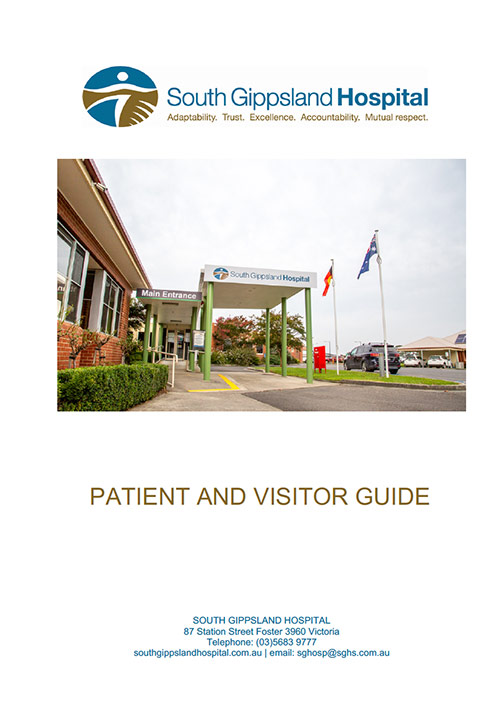
Together with our community, SGH have developed a Patient and Visitor Guide for patients admitted to our acute ward. The guide contains details about your stay, your care plan and other general information to make your time with us as safe and comfortable as possible.
Some key information from the guide is included below.
Activity
We aim to minimise the number of patients who fall, develop pressure injuries, develop blood clots and lose their normal level of function.
In order to achieve this and improve recovery and general health, patients are encouraged to:
- Get dressed in everyday clothes and wear comfortable walking shoes. Research has found that if people stay in their pyjamas all day, they tend to walk less (called PJ Paralysis)
- Sit out of bed for meals
- Reposition yourself in bed and walk around as much as possible, if it is safe to do so
- Check your skin every day and report any redness or tenderness in any areas prone to pressure injury (elbows, buttocks, hips and heels)
- Maintain a healthy diet and drink plenty of fluids (if you are not on a restricted fluid intake).
With your permission, patients may be referred to a Physiotherapist who can develop an exercise program, supported by an allied health assistant. The physiotherapist, allied health assistant and nursing staff can assist patients to move in bed, and get up and about as much as you are able to.
If you wish to leave the ward, for example to go for a walk in the hospital grounds, please advise the nursing staff who will ensure you are safe to do so.
If you need to leave the hospital grounds for any reason, please liaise with your nurse as permission must be obtained from the staff on duty and a leave form needs to be completed and signed. You will be asked to sign in upon your return.
Advance Care Directive
If you are over 65 and / or have a chronic illness you are strongly encouraged to develop an Advance Care Directive in conjunction with your doctor. This plan will document your wishes regarding future care if you are no longer able to make decisions for yourself.
If you already have an Advance Care Directive, it is important that you bring a copy of it into hospital so that we are aware of your wishes and can provide your care accordingly. Please visit the Office of Public Advocate website for information on Advance Care Directives.
If you are worried – about yourself or a loved one
You or your family can raise concerns about your health condition deteriorating.
We recognise that you and your family members know you the best, and may be the first to recognise a change.
Please talk to nursing or medical staff if you recognise a change that you believe may need additional treatment, so that we can check and monitor closely. Talk to the Nurse in Charge if you feel worse, concerned or worried.
We also encourage you to raise concerns during times of bedside handover between staff shifts. Staff support patient and carer involvement and we want you to work with us to create the best experience for you and your support people.
Rooms and services
There are two single bed rooms and the remaining are twin share.
Each has a bedside locker for holding personal belongings, height adjustable table for meals and at least one adjustable chair.
Two of the rooms have ensuites and there are additional bathroom and toilet facilities on the ward. Your nurse will provide assistance with your daily hygiene and provide fresh towels and linen as required.
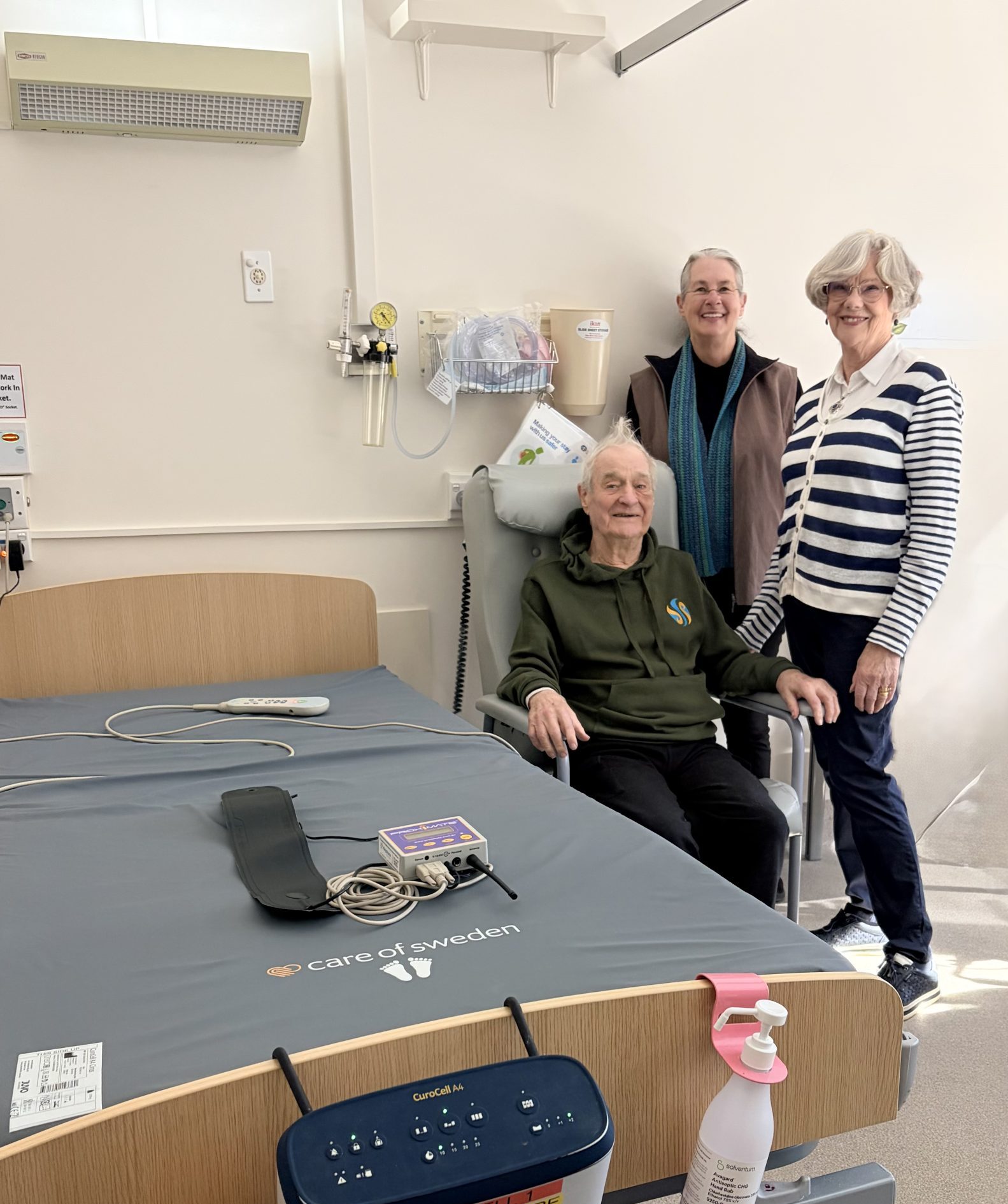
The hospital beds are electric and have a variety of adjustable positions. This allows for customised comfort and safety for individual patients and staff. In addition, there are a number of pressure relieving mattresses and other equipment available if required.
Each bed has a television and radio station option operated by a handset that is also the nurse call bell system. If you require assistance you can alert the nursing staff by using the green call button located in the middle of the television hand set.
A patient lounge is available at the end of the main corridor that has recliner chairs, magazines, books and a television. It also provides easy access to our external garden area.
Medication
Your medications will be locked in your bedside locker and any high-risk medications placed in the drug safe. These will be returned to you when you return home.
Meals
Our kitchen provides meals at these times:
- Breakfast around 8.00 am
- Lunch around 12.00 pm
- Evening Meal at 5.00 pm
Morning tea, afternoon tea and supper are also provided. Please let staff know of any special dietary requirements.
Food and alcoholic drinks should not be brought into the hospital without approval of the Nurse-in-Charge.
Staying Safe
An identification band will be placed on your wrist or ankle during your stay so that we can clearly identify you. The band will have your name, date of birth and medical record number. You will be asked by staff to state your name and date of birth throughout your stay so that we can ensure that we correctly match you to your intended treatment.
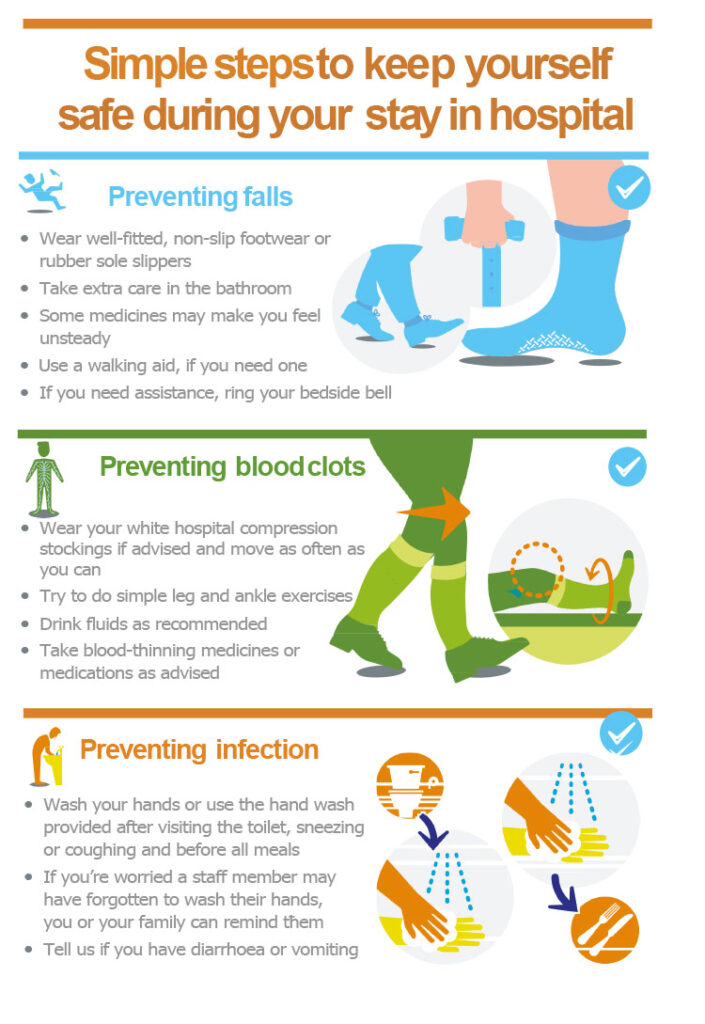
During your stay prevent falls by calling for assistance rather than risk having a fall. It’s surprisingly easy to fall or slip while in hospital as it is an unfamiliar environment and medication and/or your condition may affect your balance.
- Take your time when standing or moving about
- Wear your glasses and safe footwear
- Use the rails and shower chairs provided
- Use a light at night
- Use your call bell to obtain assistance if required.

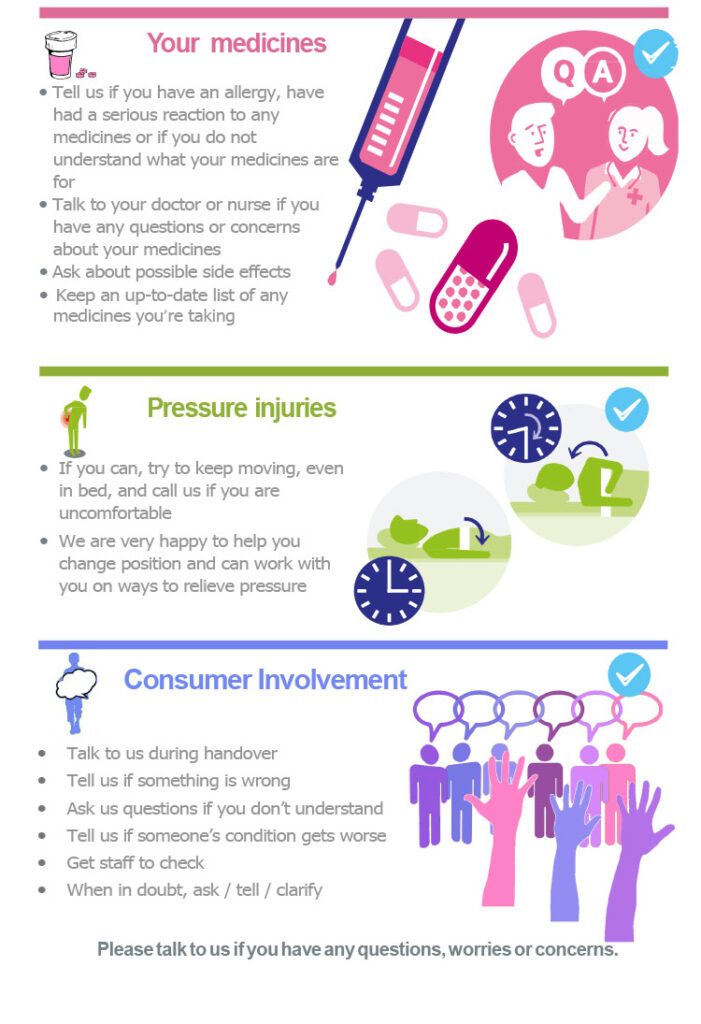
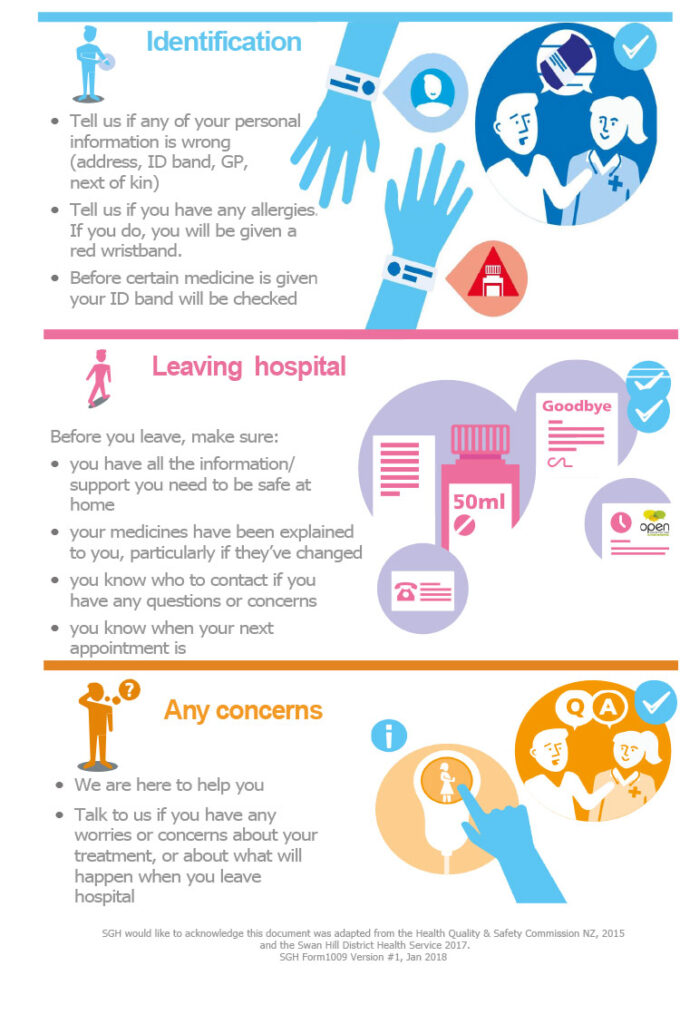
Prevent spread of infection by using good hand hygiene.Wash your hands with soap and water or use a sanitiser hand rub. You have the right to ask your visitors and any staff member if they have performed hand hygiene before they approach you.
Please take some time to have a look at the “Making your stay with us safer” booklet found beside your bed.
Your treating team
Staff involved in your care may include nurses, doctors, allied health, administration, kitchen, maintenance and cleaning staff, spiritual care practitioners, students and volunteers.
Generally, a primary nurse is allocated each shift for your care however as we work as a team more than one nurse may care for you on any one day. The three nursing shifts that cover a 24-period are:
- Morning shift 7.00 am to 3.30 pm
- Afternoon shift 2.30 pm to 11.00 pm
- Night shift from 10.45 pm to 7.15 am
Handover occurs at the start of each shift where nurses communicate relevant information to the next team of nursing staff. The morning staff will hand over to the afternoon staff at your bedside. You are encouraged to participate in this process by sharing your health information and asking any questions.
Observations (blood pressure, pulse, temperature) will be performed regularly while you are in hospital.
The whiteboard / journey board, located near your bed will be used to help you know who is looking after you on any day and note any important activities and reminders for the whole team looking after you.
If you have a concern regarding any of your nursing care, please notify the Nurse Unit Manager or ask to speak with the Director of Nursing.
Doctors usually visit patients on a daily basis, often in the mornings. If your treating doctor is away for the day, generally another doctor or the on-call doctor will see you if required.
SGH offers an excellent clinical learning environment and patients are a crucial component of student learning. Communication skills, empathy and compassion are best learnt by direct interaction with patients. The types of students you might meet include nursing, midwifery, medicine, radiology, physiotherapy, occupational therapy, dietitians, speech pathologists and social workers.
Students work under the supervision of a qualified professional and you will be advised if a student has been assigned to your care team. If you have a strong objection to a student providing your care you can request not to have a supervised student look after you.
You’ll be cared for by a dedicated team of professionals working together to support your comfort, wellbeing and recovery.
Leaving Hospital
You may require ongoing treatment and support once you are discharged from hospital. This can include occupational therapy, district nursing, meals on wheels or home help. Follow up information, including access to community supports and appointments will be discussed with you prior to you leaving. If you have any concerns about going home, please raise these with our staff.
Things for you to consider before leaving hospital are:
Equipment and support
- Do you require any equipment such as a shower chair, toilet seat or mobility aid?
- Do you have someone who can support you at home?
Medications
- Do you have a current medication list to take home?
- Please ask nursing staff or your doctor to explain what medications you are on and how to take them.
Transport
- Do you have a family member or a friend who can pick you up by 11:00 am on your planned discharge date? If you require assistance getting home, such as a taxi, please discuss this with a nurse.
In the unlikely event that you choose to discharge yourself against medical advice you will be requested to sign a disclaimer form. Your cooperation with this matter will be appreciated.
Security
We prefer you don’t bring valuables and large amounts of money with you into hospital, so please send any valuables home with family/carer or request they are placed in the safe. The Hospital takes no responsibility for any lost or stolen property.
For everyone’s safety and security, the main entrance doors are locked at all times outside visiting hours. Other entrances can only be accessed by staff. Closed Circuit Television (CCTV) cameras are located throughout the hospital site.
SGH has zero tolerance to aggressive behaviour. Any violence or aggression towards staff, other patients or visitors will not be tolerated. Should this occur, the Police will be called and legal action could be initiated.
Visiting Hours
We recognise the importance of visitors for the support of patients and their recovery. Visiting hours will be as flexible as possible while ensuring patient safety and maintaining the operational needs of the Hospital. You also have the right to request to not have any visitors.
If there are occasions where these times are not suitable, please discuss this with the nurse looking after you, as the Nurse-in-Charge may be able to approve an exemption. Visitors have a responsibility to respect the Australian Charter of Healthcare Rights for ALL patients in the Hospital. If any behaviour is in breach of these Rights, they are to be reported to the Nurse-in-Charge.
For the most up-to-date visiting hours and restrictions, please ask the Nurse-in-Charge or refer to our Visiting hours and guidelines page.